

It’s 9:30 PM on a Tuesday. The office is eerily quiet, except for the dragging sound of the trash bag filled with empty pizza boxes and spent confetti cannons. You’ve just wrapped up a massive product launch, three months of coding, coffee, and stress culminating in two hours of high-fives and champagne in plastic cups. The team has headed out to celebrate, but you stayed behind to clean up the war room.
When you badge out at the main exit, the reader beeps, and a reassuring, crisp green light flashes. The AI-powered cameras overhead track your movement, logging your exit to the millisecond. Inside, the building is a fortress of silicon, sensors, and predictive analytics. On paper, you are currently the safest person in the city.
Then the automatic doors slide open, and you step into the parking garage.
The lighting is dim. Suddenly, all that AI technology inside the building feels far away. The fancy AI dashboard can’t walk you to your car. A predictive algorithm can’t de-escalate a confrontation with a disgruntled employee. The latest application won’t deter bored teenagers from turning the garage into a canvas.
In that split second, the adrenaline hits. The "smart building" feels cold.
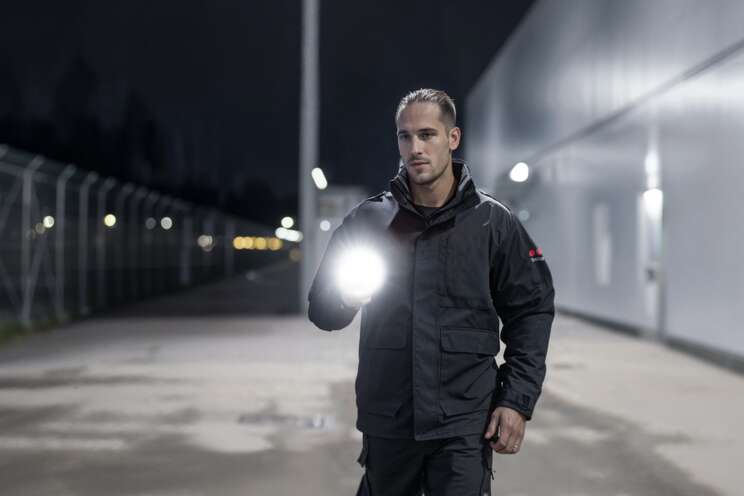
Then you see him. It’s Officer Miller, doing his rounds in the patrol vehicle. He slows down, rolls down the window, and gives a quick wave. "Late night? Same here. The parking garage is all clear. Get home safe." Just like that, the tension snaps. Your heart rate is dropping. You shake the thoughts, and the parking garage no longer feels like a horror movie set.
This is the paradox of modern security. We’re living through a digital revolution that’s rewriting the rules of risk. We are drowning in data, obsessed with AI, and chasing the promise of "autonomous everything." But in the rush to automate, we’re running into a complex, undeniable truth:
Safety isn’t a math problem. It’s a feeling, and you cannot code it.
The future of security isn’t about choosing between AI and officers. It’s about recognizing that without an officer, AI is just expensive electricity. Let’s talk about why the human element isn’t obsolete with Connor Nash, Digital Programs Manager at Securitas USA.
The misunderstanding of “security”
One of the biggest misconceptions Nash still hears is that people are asking for “security,” when what they really want is something else entirely.
“The biggest misconception is that clients want ‘hospitality with a badge.’” Technology can observe, record, and flag activity, but it can’t create an experience. Connor compares it to music: “That’s like saying, because we have Spotify, we don’t need live concerts. The function is similar, but the experience is radically different.”
This misunderstanding often appears in conversations about automating front-line roles. “Can’t we just automate the front desk?” Technically, yes. But a kiosk won’t notice when an employee looks devastated after receiving bad news. It won’t offer a reassuring nod to a visitor who’s lost or anxious. Presence still matters.
Detection vs. Resolution
When organizations assume technology can replace human presence, Nash reframes the conversation with a simple question: “If the monitoring alarm goes off at 2:00 am, do you want an email alert, or do you want a person responding with a plan?”
Technology excels in detection. Humans excel at resolution.
AI helps filter noise, processes massive volumes of data, and surfaces what matters most. That capability doesn’t eliminate the officer; it gives them time and focus. “AI buys you time and focus. It filters out the noise so the human officer can focus on the signal.”
The one thing AI still can’t do
Despite rapid advances, there’s a human capability that no neural network has truly mastered: context.
“An AI sees ‘motion in a restricted area.’ A human officer sees ‘the CEO, who forgot his badge again, looking for his umbrella.’”
Algorithms operate in binaries, with outcomes categorized as safe or unsafe, authorized, or unauthorized. Officers can navigate the gray areas where rules conflict with reality. They can read body language, understand nuances, and reconcile rules with reality. This ability to “read the room” helps officers determine whether something is unusual but harmless or genuinely risky.
From incident to interaction
That contextual awareness can often turn potential incidents into moments of trust.
Connor has seen it firsthand. A camera flags a “loiter” in a parking lot. An automated system might trigger a siren or dispatch police. A human officer walks out and realizes it’s a teenager with a flat tire and a dead phone.
“Instead of a conflict, you get a service assist. You turn a potential threat into a moment of brand loyalty. That is the human advantage.”
Technology as an amplifier, not a replacement
Rather than replacing officers, the most effective security programs use technology to help amplify human strengths.
Connor likens AI to an Iron Man suit. “Tony Stark is cool, but Tony Stark in the suit is the superhero.”
The goal is to eliminate “robot work,” tasks like standing in one place for eight hours or manually checking long access lists. When AI handles repetitive, high-volume tasks, officers are free to do what only humans can: walk the floor, engage with people, help identify hazards, and build relationships.
Technology can also sharpen situational awareness. Instead of searching for a needle in a haystack, “the AI hands them the need,” Nash explains, leaving the officer to decide what to do next.
Culture makes a difference
Whether officers remain central or sidelined depends less on the technology itself and more on organizational culture.
“It requires a leadership vision that views technology as subservient to the officer.”
If a command center turns officers into button-pushers, the model has failed. The standard must be clear: the machines can provide the data; the human makes the decision. Officers must be trained and empowered to trust their intuition, even when it conflicts with the algorithm.
“If the AI says, ‘All Clear,’ but your gut says something is wrong, we want you to investigate,” Nash emphasizes.
Rethinking recruitment and training
As the role evolves, so must the way the industry recruits and develops talent.
“For decades, the industry may have hired based on size and intimidation factor. Today, I’d rather hire someone with a background in analytics or hospitality than someone who can bench press a Buick.”
The shift is from guarding assets from people to helping protect people and assets through intelligence. The modern officer understands data, can interpret insights, and proactively helps mitigate risk.
Why human presence isn’t going away
Ironically, the more digital the world becomes, the more we crave human connection. Consider one of the most technologically advanced retail environments in the world. The products are sleek, intuitive, and designed to work seamlessly right out of the box. Yet the stores themselves are filled with people. Approachable, knowledgeable staff whose job is to listen, troubleshoot, and translate complexity into clarity. When something goes wrong, customers don’t want to talk to a screen. They want to talk to someone who understands.
Security is no different. As threats become more complex, the need for a human trust layer increases. Human presence helps provide judgment, intuition, and credibility in moments where technology alone falls short. AI can surface anomalies. Officers can determine intent. As environments become smarter, the role of the officer doesn’t become less important, but more essential.
The future is human, informed by intelligence
As AI accelerates, it’s easy to get distracted by shiny objects and fixate on what technology can do faster. But speed isn’t the point. Purpose is.
The real story of modern security isn’t about machines replacing people. It’s about people empowered by better insights. Officers whose roles are elevated, not erased. In a world full of sensors and signals, the human element remains the one thing that turns information into understanding, presence into reassurance, and security into trust.
